Skip to main content
Industry News Carrier and logistics headlines. Open the original source for the complete article.
Browse by topic Showing: Trade Press
424 headlines
Fixed Fee. No Gain Share.
Industry FreightWaves - Trucking · Jul 25, 2026
The Freight Rate Index fell 9.5 points month-over-month to a seasonally adjusted 70.2 in June, down from May’s record 79.7. The Capacity Index climbed 1.5 points to 55.0 in June, a 43-month high, even as Class 8 sales remain below replacement levels industrywide. A wave of new regulations from the Federal Motor Carrier Safety Administration(FMCSA), including nondomiciled CDL restrictions, tighter ELD and registration fraud enforcement, and driver school closures, sent the index to a five-year low of 30.4 in April after the nondomiciled rules took effect in mid-March.
Christopher Doering/Supply Chain Dive Listen to the article 3 min This audio is auto-generated. Conagra Brands plans to invest an incremental $125 million in fiscal 2027 to strengthen its supply chain and lower costs by moving more production in-house, President and CEO John Brase said on a July 15 earnings call. The spending will contribute to the company’s goals of improving supply chain resiliency, maintaining high service levels and reducing inventory and days of inventory, according to the call.
“That’s a lot of material that was, poof, gone,” he said. Businesses along those supply chains broadly recognized that “it would take some time for the infrastructure that was damaged, and production facilities that were impacted by the conflict, to come back to normal production levels” once the war ended. Price spikes and more challenging logistics for virgin resins this year have opened doors for recycled grades, making their traditionally higher prices more competitive for customers, including packaging converters.
A review of the Federal Register from 2024 through the present reveals that the last time FMCSA rejected either a new request or a request for renewal of an exemption was in September 2024. But in the June 23 Federal Register announcement that all 52 requests had been denied, FMCSA said it had received no comments on the request. FMCSA approved a group of 63 individuals under the epilepsy exemption as recently as June 18, five days before the denial of the group of 52, suggesting no change in policy can be read into the recent negative actions after almost two years of approvals.
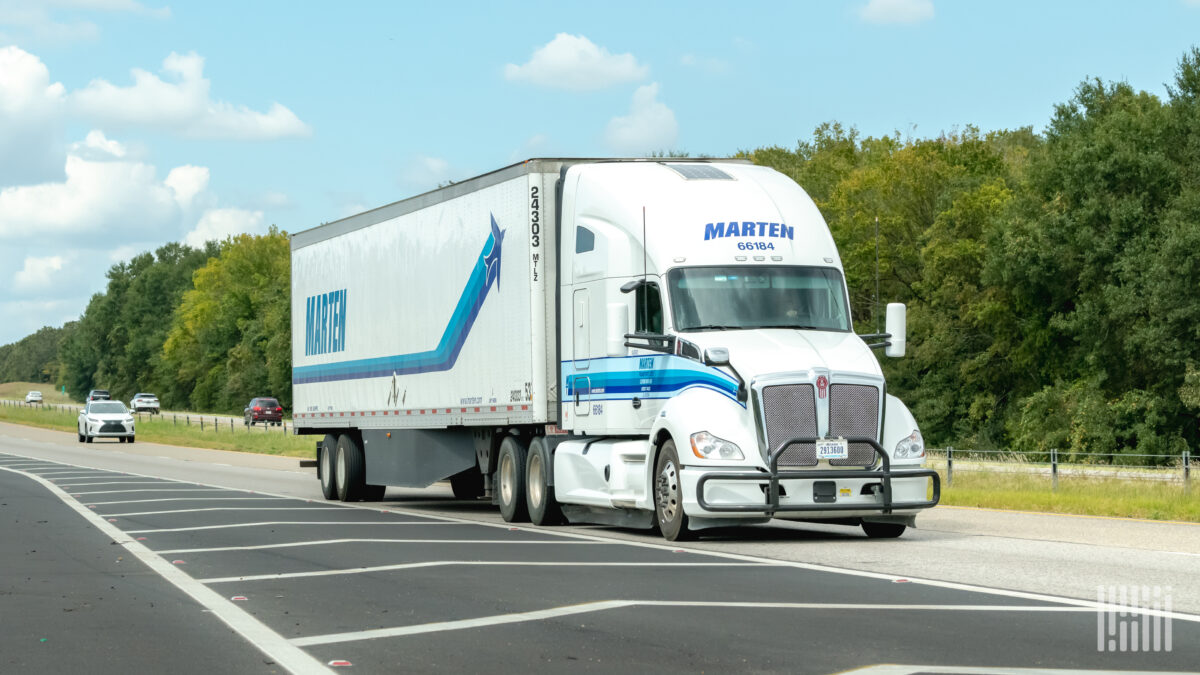
A much tighter capacity backdrop is allowing the company to improve its freight selection and raise rates. An 8% decline in average tractors in service was offset by a 9% increase in revenue per tractor. Table: Marten’s key performance indicators – TL & DedicatedThe company’s smaller dedicated segment saw a 14% y/y decline in revenue (ex-fuel) as a 17% drop in truck count was only partially offset by a 3% increase in revenue per tractor.
Goods from China, the European Union and Mexico will be among those affected by the Section 301 tariff, with certain countries’ exports to the U.S. facing a 10% rate and others being hit with a 12.5% charge, per a Federal Register filing. For imports from countries with Most-Favored Nation rates, such as the European Union, Japan and South Korea, the tariff charged will be net of the MFN duty, per the filing. Section 301 forced labor tariff rates by country The tariff rates the U.S. will charge for imports from each trading partner included within the Trump administration’s levies tied to forced labor.
The carrier reported better-than-expected results on Wednesday, highlighted by contract rates that climbed throughout the period and a tender rejection rate that was twice the industry average. Table: Knight-Swift’s key performance indicators – ConsolidatedTruckload revenue increased 3% y/y to $1.1 billion as a 6% increase in revenue per tractor was only partially offset by a 3% decline in average trucks in service. Knight-Swift’s TL guidance calls for a mid-single-digit y/y revenue increase in the third quarter, with the adjusted OR improving 650 to 750 bps y/y (implying an 89.2% adjusted OR).
Unlike its first-generation trucks, the new fleet is built to run with no passive observer at all, the safeguard that has ridden along on the rest of Aurora’s driverless fleet since its public-road debut last year. “We believe AUR’s launch of fully driverless operations using its Gen2 hardware is a significant milestone toward commercial deployment of the technology at scale starting in 2027,” Ravi Shanker, equity analyst at Morgan Stanley, wrote in a research note. Deploying at scale means building trucks faster, and Aurora is leaning on a manufacturing partner to do it.
Growth in last-mile delivery for big and bulky e-commerce items has slowed by half because stagnant home sales mean people are ordering fewer large-ticket discretionary items like furniture and appliances, cutting into profit margins, according to a report from Armstrong & Associates and the National Home Delivery Association. Carriers surveyed by Armstrong & Associates also cited cost concerns from the rising cost of cargo insurance and less-than-truckload capacity scarcity in the middle-mile to warehouses. Gross margins in big and bulky delivery have dipped from 28.9% in 2022 to 27.5% last year, the report said.
The Staged Accident Fraud Prevention Act would make intentionally causing such a collision a federal crime. Attorneys, physicians and other knowing co-conspirators could also face prosecution. The Owner-Operator Independent Drivers Association endorsed Moody’s legislation.